Demonstration site · built by Akrodos · akrodos.com
Design / Excavation / Gunite / Finish
A pool is a building, and it is built in your garden.
That is the last afternoon of the job, and it is the picture every builder shows you. What you are actually buying is the eight weeks before it: a hole, a cage of steel, a day of concrete, and a month of waiting for the water to settle down. The rest of this page is about that part, because it is the part that decides whether the first picture was worth it.
6in
Minimum shell
Walls and floor, measured after carving. Thicker at the bond beam and under the deep end.
7days
Water cure
The shell is hosed down twice a day. Concrete reacts with water, it does not dry out.
28days
Startup
New plaster keeps curing underwater. The chemistry is watched daily for the first month.
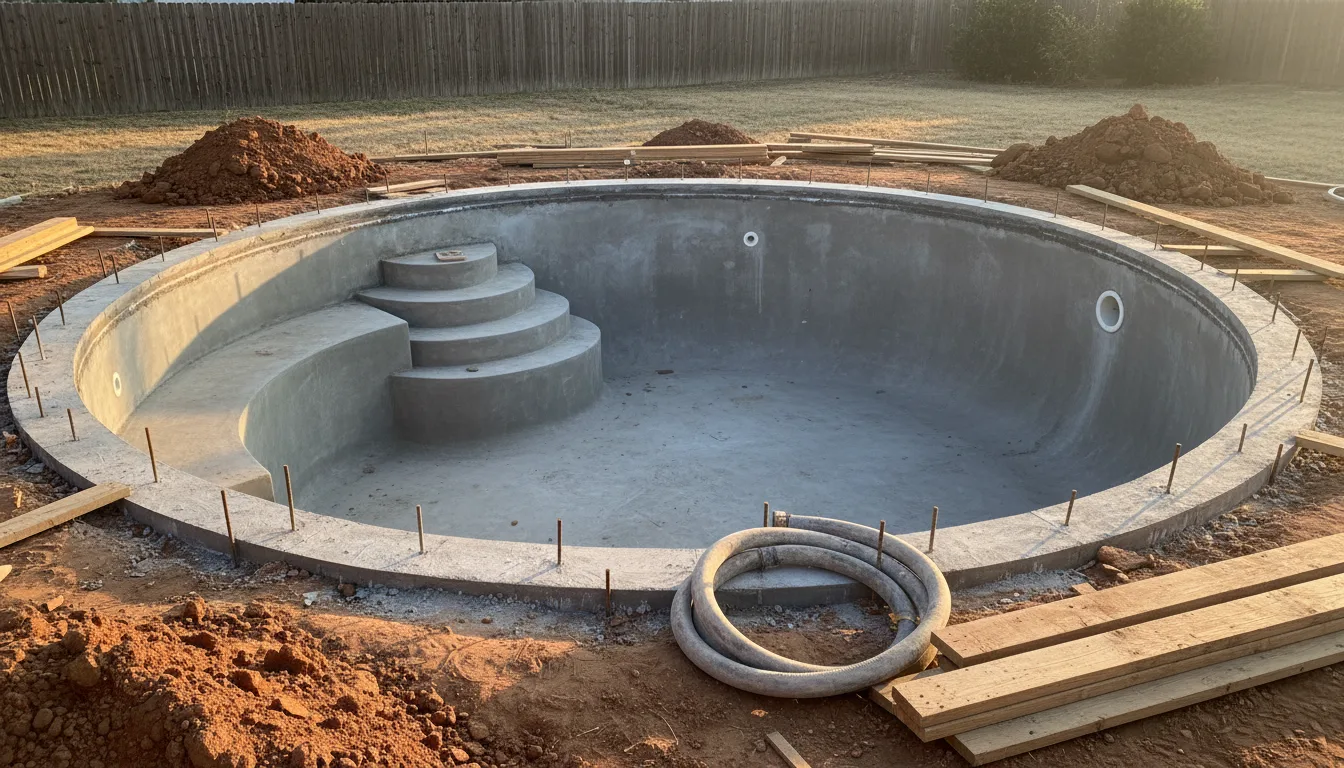
Stage 03 of 07
For most of the build, this is your garden.
Nobody photographs this part, which is exactly why it is worth knowing what it involves before you sign anything.
Seven stages, and what stops each one.
Tap a stage
1 to 3days
Layout and dig
- What happens
- The shape is painted on the grass, batter boards and string lines go in, and the excavator takes the hole out to the shape of the shell plus room to work.
- What you see
- A hole, a pile of spoil, and tracked ruts across the lawn. This is the day the garden looks worst.
- What stops it
- Rock, groundwater, or a utility nobody marked. Any of the three turns a one day dig into a week and changes the number.
Six to ten weeks of work, and three to five months from signing. The difference between those two numbers is permits, inspections between stages, and weather, and any builder who quotes you only the first number is quoting the easy half.
Three ways to hold water
Pick the shell before you pick the shape.
This choice decides the timeline, the budget and what the pool will ask of you in fifteen years. Everything else is decoration on top of it.
Gunite
8 to 12 weeks
Sprayed concrete over steel, on site
Any shape and any depth, and the shell is repairable and resurfaceable for decades.
The longest build, the most disruption, and the interior finish is a wear item that gets redone every ten to fifteen years.
Fibreglass
2 to 4 weeks
One moulded shell, craned in
Fast, and the surface is smooth and non porous, so it holds less algae and asks less of the chemistry.
Only the shapes and sizes the moulds come in, and the shell has to physically fit down the side of the house.
Vinyl liner
3 to 6 weeks
Steel or polymer wall panels, liner fitted
The lowest cost to build, and a liner change is a straightforward way to make an old pool look new.
The liner is consumable. Expect to replace it roughly every seven to twelve years, and expect to be careful with anything sharp.
The same pool, four times.
Plates 01 to 04
Example imagery, not photographs of completed jobs. A live site would carry the owner’s own pictures of their own work here.
Questions people ask
Six to ten weeks of actual work for a gunite pool. Plan on three to five months from signing, because permits, inspections between stages, and weather all sit in the gaps rather than in the work.
Usually, with a mini excavator and a conveyor, and it adds days rather than making it impossible. Access is the first thing to look at on a site visit, because it changes both the price and which shell types are even available.
It sits at the water level and takes the abuse that the finish underneath it cannot. Oils, sunscreen, and the scale that forms where water meets air all collect in that band, and glass or ceramic cleans where plaster stains.
Concrete does not dry, it reacts with water, and that reaction keeps going for weeks. A shell that is allowed to dry out in the first seven days ends up weaker and more prone to cracking than the same shell that was hosed down twice a day.
Yes. New plaster picks up a permanent ring wherever the water stops for any length of time, so the hose runs continuously until the water is over the tile. On a normal residential pool that is one to two days.
A hydrostatic relief valve in the main drain lets ground water push into an empty pool rather than lift it. It is the reason draining a pool is a job for somebody who knows the water table, not a weekend task.
Book a site visit
Tell us about the garden.
How you get to the back, roughly how much space there is, and whether anything has ever been dug there before. Access decides more about a pool than shape does.
Placeholder number. Nothing on this site connects to a real line.